

Galatina is a town of 27,555 inhabitants in Salento, in the province of Lecce, the third largest town in the province by population. Halfway between the Ionian and the Adriatic, 20 km south of Lecce, it is one of the most populous towns in southern Apulia.
The town was built on the eastern slope of a hill, with the old centre laid out so as to collect the rainwater flowing from the west in deep cisterns dug into the limestone. The red soil is very fertile and, in some places, clayey.
The main crops are vines and olives, although artesian wells have also made it possible to grow early fruit and vegetables. Besides tobacco, the town produces the typical Sieglinde new potato for export.
Galatina has many important sights: the public gardens in the main square; Porta Luce, rebuilt in 1795; the Church of the Addolorata, built in 1710; and the Church of the Carmine, built between 1670 and 1724.
Palazzo Tafuri-Mongiò, built in 1580 as the inscription in its courtyard records, had its upper floor embellished in the last decades of the 18th century by the architect Emanuele Orfano from Alessano.
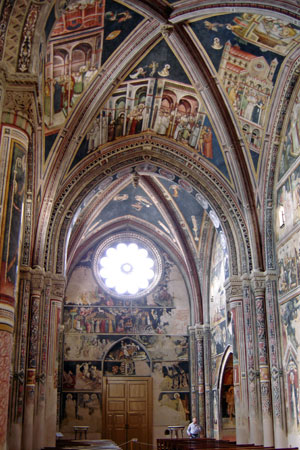
Not to be missed is the Basilica of Santa Caterina, a national monument whose interior, entirely frescoed by Francesco d’Arezzo in 1435, makes it a popular destination. It is in Apulian Romanesque style, with a large stone rose window and finely carved portals. The majestic interior is a picture gallery in its own right.
The Church of the Battenti is dedicated to the Holy Trinity; its name comes from the instruments the brothers used to flagellate themselves during the Easter rites. The Convent of the Poor Clares was built between 1605 and 1620, with its church now dedicated to Saint Louis. The nuns moved into the convent in 1628.
The Baroque Mother Church, dedicated to Saints Peter and Paul, was built from scratch in 1633 on the site of an earlier church where the Greek rite was used until the time of Pope Sixtus IV. Of great interest are the vault frescoes, the splendid polychrome marble altars, the old Chapel of the Sacrament, the fine paintings and the statues. Another landmark of the town, a few steps from the gardens, is the small church of San Paolo.
According to tradition, the well inside the church, now walled up for hygiene reasons, gave water that could heal those bitten by spiders such as tarantulas.
Tradition says that the “tarantati” first performed a musical exorcism at home; then, to the pressing rhythms of local music, they went to the chapel to call on the Saint or thank him for the grace received. Only after drinking the miraculous water and vomiting into the well could the grace be considered granted, and every year, on 28 June, they came back to “renew” it. Hence the yearly gathering of the “tarantate”, still alive today.
Outside the old town you can visit other churches, such as the Church of the Immacolata, rebuilt and reopened for worship in 1738; the Parish Church of San Biagio, begun in 1507 outside the town walls and altered many times up to 1683, when the square bell tower beside it was built; the Sanctuary Church of the Madonna della Luce; and the Parish Church of the Immaculate Heart of Mary.
